


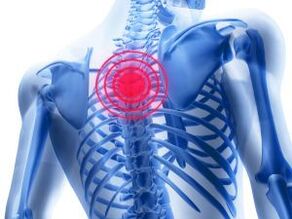
Clinically, thoracic osteochondrosis (chondrosis) is manifested by sharp, piercing or dull pain, aching, cracking and clicking when bending and stiffness.
The pathology is characterized by numerous specific symptoms - a feeling of lack of air during inhalation, discomfort in the region of the heart and even a sore throat.
The treatment of the pathology is mainly conservative with pharmacological drugs.Physiotherapy procedures, massage sessions are also carried out, and the help of chiropractors is required.
If such treatment is ineffective, the patient is indicated for surgical intervention.
Details about symptoms
Symptoms of osteochondrosis of the thoracic spine never appear all at once.In the initial stage of the development of this degenerative-dystrophic pathology, only slight discomfort is observed in the back.Patients take them for trivial overwork after a hard day at work and write them off as "stiff" muscles due to being in one position for a long time.
But the intensity of concern is slowly, steadily increasing.Unpleasant sensations are replaced by severe pain, complicated by limited range of motion, dizziness and headache.In medicine, all symptoms of osteochondrosis of this localization are divided into several groups.This helps to diagnose faster and decide on treatment tactics.
Note!Symptoms of thoracic osteochondrosis in men and women do not differ in character, severity or localization.But in the representatives of the stronger sex, they may occur a little later due to a stronger musculoskeletal system.Also, some men experience erectile dysfunction due to osteochondrosis.
Vertebral symptoms
Under the influence of unfavorable factors (hypothermia, increased physical activity), the long-term remission of thoracic osteochondrosis can be interrupted by a sudden attack of acute pain.Even more often, it is caused by prolonged standing in one body position, for example, sitting.If a person stands up suddenly, there is such a sharp pain in the back that he loses the ability to move for several minutes.
In medicine, this condition is called dorsago.It differs from ordinary pain in accompanying symptoms:
- feeling of lack of air during inhalation;
- pronounced stiffness.
The course of the pathology is often complicated by dorsalgia - pain in the thoracic spine, the intensity of which increases gradually.It intensifies when you bend or turn your body to the sides.In order not to experience pain, a person takes a forced position.At the same time, it involuntarily strains the back muscles, involuntarily provoking their overload.Now they are also starting to hurt, especially when they walk.
Extravertebral symptoms
With the development of thoracic osteochondrosis, the intervertebral discs become thinner and destroyed.These cartilage pads can no longer distribute the resulting loads and prevent the vertebrae from hitting each other.A compensatory response of the body is triggered - bone structures begin to deform with the formation of growths.They put pressure on sensitive nerve endings and encroach on the spinal canal.Therefore, specific symptoms of thoracic osteochondrosis occur in women and men: loss of sensation in certain areas of the body, a burning sensation and crawling "goosebumps".
Important!Osteochondrosis of the thoracic localization is often manifested as a dry, unproductive cough, sore throat, a feeling of a lump in it, as well as urination disorders.
But that's not all.The spinal roots are responsible not only for the innervation (transmission of nerve impulses) of the spine, but also of the internal organs.Therefore, when they tighten, discomfort appears from the liver, kidneys, digestive tract and myocardium.What are the signs of thoracic osteochondrosis that are not characteristic of back pathologies:
- pain in the cardiac region, identical to the return of angina, shortness of breath, the feeling of "compression" of the heart;
- panic attacks, psycho-emotional instability, fear without cause, anxiety, sleep disorders;
- discomfort in the epigastric region, nausea attacks, sometimes leading to vomiting, sour belching, bloating, boiling and rumbling in it;
- disturbances of peristalsis - constipation or diarrhea;
- long, labored breathing with crying.
The pain is not localized directly in the area of the destroyed intervertebral disc and (or) formed intervertebral hernia.They radiate along the nerve.Signs of osteochondrosis of the chest region can be disguised as renal abdominal pain, symptoms of gastritis, gastric ulcers, hepatitis, pancreatitis, cholecystitis and even gastroenteritis.
Compressive myelopathy
This is called extravertebral syndrome, which is rarely encountered in clinical practice.It is observed in stages 3-4 of the disease, when due to the loss of stability of the spinal segment, the nucleus pulposus protrudes from the annulus fibrosus.An intervertebral hernia is formed, which constantly puts pressure on the spinal cord.When visiting a vertebrologist or neurologist, patients complain of frequent girdle pain radiating to the hip area.At the same time, there are feelings of weakness and numbness in the lower extremities.
Against the background of spinal cord damage, the innervation is seriously interrupted.In the absence of treatment, the functional activity of the organs located in the pelvis decreases.Compression myelopathy causes problems with bowel movements.And due to the pronounced narrowing of the diameter of the spinal canal, the sensitivity of the legs is greatly reduced.In severe cases, patients are diagnosed with paresis (partial or complete paralysis) of one or both lower extremities.
Symptoms of forgiveness
Outside of relapses, osteochondrosis of the chest almost does not bother a person.From time to time, there are annoyances, aches, dull pains in the back, which usually go away after a long rest.But as soon as you slightly increase the load on the spine, lift a heavy object or bend over, another relapse follows.It can also be caused by the following factors:
- stressful situation, depressive state;
- hypothermia, sudden temperature changes;
- staying in one body position for a long time;
- alcohol abuse;
- unbalanced diet, lack of foods rich in calcium, phosphorus, manganese, molybdenum in the diet.
Sometimes the remission phase ends because of a person's efforts to avoid another relapse.He visits a chiropractor or massage therapist with a dubious reputation or little practical experience.An attempt to stretch the spine leads to another aggravation.
Basic treatment methods
It is not yet possible to completely cure the pathology, so all the efforts of doctors are aimed at improving the patient's well-being.Patients are recommended to wear orthopedic products (corsets, bandages), which adjust the vertebral structures and prevent their displacement.Drugs of various clinical and pharmacological groups are prescribed, physiotherapeutic measures and exercise therapy are performed.
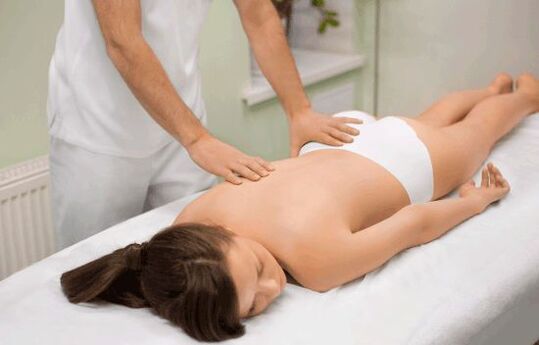
The movements of the chiropractor's hands are aimed at increasing the spaces between the vertebrae, which are reduced with thoracic osteochondrosis.
Important!With thoracic osteochondrosis of high severity, conservative treatment is useless.Patients are immediately offered surgical intervention - removal of intervertebral hernia, arthrodesis, placement of implants in place of the damaged disc, bone grafting.
Drug therapy
The treatment of osteochondrosis of the thoracic spine is aimed at eliminating all symptoms and inhibiting destructive and degenerative processes.During periods of irritation, solutions for parenteral administration are used, which show effects after 5-10 minutes.Then the result is ensured by a course of taking tablets, applying ointments and gels.In the remission phase, mainly external agents are used, which have a milder effect on the body.
Nonsteroidal anti-inflammatory drugs (NSAIDs)
This is the group of drugs most used in the complex treatment of thoracic osteochondrosis.Their active ingredients block the biosynthesis of mediators of pain, inflammation and fever from arachidonic acids.Even after a single use of NSAIDs, a person's well-being improves significantly:
- pain severity decreases;
- The unpleasant clicking sound that occurs when turning the body and bending disappears;
- inflammatory processes in soft tissues weaken, swelling resolves;
- the range of motion in the chest region increases.
To stop relapses, solutions for intramuscular administration are used.Medicines in capsules or tablets deal with moderate pain.And ointments and gels quickly eliminate mild discomfort.
Preparations with B vitamins
Innervation disorders are well treated with drugs containing B vitamins. They improve the transmission of nerve impulses in the central and peripheral nervous system and stimulate the restoration of damaged spinal roots.The composition of the products includes thiamine, riboflavin, pyridoxine, cyanocobalamin.
In the first week of therapy, intramuscular injection of drugs is practiced, which, in addition to vitamins, contain lidocaine, which immediately eliminates pain.And then patients are advised to take pills for a month.
Glucocorticosteroids
The use of these synthetic analogues of hormones produced by the adrenal glands is practiced when safer means are ineffective.Glucocorticosteroids are prescribed to patients for acute, stabbing pain in the back, radiating to the internal organs.Medicines can also be taken orally, but much more often they are administered parenterally, including at the sites of damaged discs.
Glucocorticosteroids are characterized by a wide list of contraindications and possible side effects.Long-term treatment of chondrosis of the thoracic spine with hormones leads to tissue damage of the liver, kidneys and stomach.Therefore, their use is prohibited for patients with cirrhosis, peptic ulcers, renal failure and osteoporosis.
Muscle relaxants
Back pain is often explained by increased tone of its skeletal muscles.To relax it, muscle relaxants are used - first in the form of solutions for parenteral administration, and then in tablets.Medicines relieve muscle spasms that cause compression of the spinal cord.Which muscle relaxants are the most effective:
- blocking of polysynaptic reflexes;
- relaxation of spasmodic muscles;
- reducing the release of prostaglandins.
Medicines are rarely used as monotherapy.Treatment of thoracic chondrosis is carried out with muscle relaxants in combination with glucocorticosteroids or non-steroidal anti-inflammatory drugs.Their significant drawback is that addiction develops quite quickly, so it is forbidden to use them for more than a week.
Chondroprotectors
Unlike drugs that eliminate the symptoms of thoracic osteochondrosis, such drugs are also used for pathogenetic therapy.This is the only group of drugs that can increase the production of chondrocytes necessary for the partial restoration of cartilage intervertebral discs.All the therapeutic effects of chondroprotectors are due to the high content of glucosamine and (or) chondroitin.
But chondroprotectors are valued not only for their ability to restore discs.Their components shine in the area of the damaged segment of the spine.After 2-3 weeks, the maximum therapeutic concentration of glucosamine and chondroitin is created.Now the drugs have started to show pronounced analgesic, anti-inflammatory and anti-edematous activity.
Recommendation!It is recommended to treat osteochondrosis with chondroprotectors in the form of solutions or tablets for injection.Despite all the manufacturers' guarantees about the effectiveness of ointments and creams, they were unable to provide evidence of their therapeutic effectiveness.
Non-drug treatment
Treatment of osteochondrosis of the chest region with pharmacological drugs should be combined with regular physical exercises.Exercise therapy is the most effective method of therapy to avoid disability.Thanks to daily training, the muscular framework of the back and the ligamento-tendon apparatus of the chest region are strengthened and the production of synovial fluid that nourishes the vertebral structures is improved.The set of exercises is determined by the physical therapy doctor after studying the results of x-ray diagnostics.He is present in the first classes and monitors the dosage of cargo.
Manual therapy for osteochondrosis is also practiced, which aims to increase the spaces between the discs and vertebrae.Dry or underwater traction (extension) of the spine is performed, and at home, hanging on a bar.The effectiveness of manual therapy increases with simultaneous physical procedures:
- electrophoresis;
- laser therapy;
- magnetic therapy;
- ultraviolet radiation;
- diadynamic currents.
Patients are shown 10-15 sessions of classical massage, vacuum, Scandinavian, with acupressure.Hirudotherapy, acupuncture and sanatorium treatment with radon and hydrogen sulphide baths are also useful.
Only with the help of an integrated approach to the treatment of thoracic osteochondrosis is it possible to eliminate further damage to the discs and deformation of the vertebrae.The implementation of the doctor's recommendations helps to get rid of all the symptoms of chronic pathology as soon as possible.